Last updated: 18 December 2025
What is This Page?
This page aims to provide players with a series of optional changes for official FFG cards, either based on developers’ rulings, on the community consensus, or on the work of the ALeP team. This page is meant for those players who feel like the official cards and rules might need some improvements and fixes, but everything that it contains is totally optional and up to each player’s discretion.
This page is divided into three sections:
The Partially Official Errata section lists a series of card fixes and rules addenda based on rulings from the developers which clarified the intent of certain situations, but without providing a definitive new wording to follow.
The Community Consensus section lists a series of card fixes and rules addenda that are based on glaring issues that were discovered over the years, but about which we never had an official answer from the developers. By working with the LOTR LCG community at large we create those items to fill the holes left by the developers’ answers.
The Free To Choose List (FTCL) is a set of optional balance tweaks for official FFG cards devised by the ALeP team. Players may use the FTCL, in whole or in part, if they want suggestions to rein in some powerful combos. The ALeP team uses the FTCL during playtesting, and we have come to enjoy finding new ways to employ powerful cards without stretching the game too much. But we recognize that these tweaks aren’t going to be for everyone, so everything in that section is completely optional! Your ALeP games are 100% legitimate whether you decide to use the FTCL or not.
When a card is referenced in this document you will find an indication like this [XX YY] after the card name. That specifies the product code (XX) and card number (YY). A list of the product codes we use can be found here.
Partially Official Errata
The following section includes a series of fixes to specific cards and rules addenda based on explicit rulings from the developers. Those rulings clarified the intent of certain situations, but without providing a definitive new wording to follow, so we are proposing it ourselves.
Any text that we propose to change will be highlighted by using red strikethrough for the old text and green for the new text.
The Lost Realm Expansion [TLR] and Angmar Awakened Expansion [AA]/Angmar Awakened Campaign Expansion [AACE]
Thaurdir [TLR 33/AACE 80, AA 98/AACE 113, AA 127-128/AACE 129a-129b] [added 19 December 2023]
Could read: “Cannot have player attachments.”
ALeP’s Note: The original version of Thaurdir had the “cannot have attachments” text to avoid having Trap or other player cards attached to it, but the introduction of Black Mare [TBoCDNM 8] in the Nightmare version of The Battle of Carn Dûm, as well as the presence of the 3 Thaurdir Objective Burdens [AACE 168-169-170] in the Angmar Awakened Campaign Expansion, clearly meant to us that the limitation was only intended to apply to player card attachments. Since Caleb Grace confirmed a similar situation for the Ship enemies in The Dream-chaser cycle (see item #3.383 of our Semi-official Errata and FAQ 1.10 page) we feel confident the same should hold true in this situation as well.
The Grey Havens Expansion [TGH] and The Dream-chaser Expansion [TDC]/The Dream-chaser Campaign Expansion [TDCCE]
Scouting Ship [TGH22/TDCCE 7]
Light Cruiser [TGH 57/TDCCE 150]
Corsair Warship [TGH 58/TDCCE 151]
Siege Ship [TDC 126/TDCCE 105]
Heavy Cruiser [TDC 127/TDCCE 106]
Ramming Ship [ASoCHNM 4]
[added 19 December 2023]
Could all read: “Cannot have player attachments.”
ALeP’s Note: The original version of these Ship enemies had the “cannot have attachments” text to avoid having Trap or similar player cards attached to them, but the mechanics of the scenario A Storm in Cobas Haven, more specifically the Dol Amroth Guarded objectives and Stage 2B Battle in the Bay [TDC 121/TDCCE 100] When Revealed effect seem to clearly require objectives to be able to attach to Ship enemies. We thus believe that the limitation on the cards that cannot be attached to those Ship enemies was meant to apply only to player cards. Caleb Grace later confirmed that the intent was indeed for the Dol Amroth Guarded objectives to be able to attach to the Ship enemies too (see item #3.383 of our Semi-official Errata and FAQ 1.10 page). To minimize the number of card errata, we propose this change only for the Ship enemies that are used in the scenario A Storm on Cobas Haven (in all its possible versions, Nightmare included), but note that it could be applied to all Ship enemies with the “Cannot have attachments” text, even though as of now that would not affect anything outside of that scenario.
The Black Riders Saga Expansion [TBR]/The Fellowship of the Rings Saga Expansion [TFotR]
Three is Company – Side B [TBR 22/TFotR 28]
A Shortcut to Mushrooms – Side B [TBR 23/TFotR 29]
Escape to Buckland – Side B [TBR 24/TFotR 30]
[added 19 December 2023]
Could all read: “When a player fails a Hide test, each Nazgûl enemy in the staging area not engaged with a player (including any still being revealed) engages that player. (Trigger Forced effects after resolving this effect.)“
ALeP’s Note: When revealing a Nazgûl enemy in the A Shadow of the Past scenario (which can also happen due to the When Revealed effects of Stage 2B and 3B), the Hide test is made and resolved while the Nazgûl is still in the process of being revealed and not yet added to the staging area. So failing the Hide test triggered by revealing a specific Nazgûl will not make that Nazgûl engage you due to the passive effect of the main quest card, since that enemy was not yet in the staging area. That is not the intent of how this quest should work and Caleb Grace issued a ruling about this issue (see item #3.213 of our Semi-official Errata and FAQ 1.10 page), proposing a fix to the quest cards language to address the issue, which we slightly changed to better reflect the intent.
Fog on the Barrow-downs Saga Scenario [FotBD]
Trapped Inside a Barrow – Side B [FotBD 4] [added 31 January 2025]
Could have this additional text: “Forced: After a player at this stage is eliminated, place 1 progress on a Great Barrow at stage 3B.“
ALeP’s Note: This scenario has an unintended situation in multiplayer where players can be locked out from victory if a player is eliminated while by themselves at Stage 4B, which makes exploring their corresponding Great Barrow impossible for the other players. Caleb Grace acknowledged this issue (see item #3.181 of our Semi-official Errata and FAQ 1.10 page) and promised to release an errata for this card, but since we still do not have one we are proposing this wording to address the issue.
The Mountain of Fire Saga Expansion [TMoF]/The Return of the King Saga Expansion [TRotK]
The Black Gate Opens Campaign Card – Side B [TMoF 74/TRotK 126] [added 31 January 2025]
Could read: “Resolution: Record the number of resource tokens on The Black Gate in the notes section of the campaign log. If a Wraith on Wings is in the victory display, remove that copy from the campaign pool. If the first player controls players control Gwaihir, add him to the campaign pool. The players have earned that boon. If a hero is in its controller’s discard pile, do not add that hero’s name to the list of fallen heroes.”
ALeP’s Note: Caleb Grace clarified in a ruling (see item #3.319 of our Semi-official Errata and FAQ 1.10 page) that the intent for this scenario was that as long as any player-controlled Gwaihir [TMoF 41/TRotK 41] at the end of the game, it was added to the campaign pool. But since in its final version objective-ally Gwaihir does not move around the table with the first player token, as written this would only work if the player controlling Gwaihir also happens to be the first player at the end of the game. Since this was not the intent we propose this wording to fix it.
Rules Addenda
Enemies that change engaged player and framework attacks [added 18 August 2023]
Framework attacks are those attacks made due to how the game itself is structured, as opposed to attacks made due to card effects like immediate or additional attacks. Usually, during the combat phase, each engaged enemy makes a framework attack against the engaged player when that player is the active player. But what happens when, during the combat phase, a card effect makes an enemy move to being engaged with another player that has not yet been the active player (for example a shadow card that says “engage the next player…”)? Will the enemy make a framework attack against the newly engaged player too (besides any immediate/additional attack made as part of the card effect)? This was a matter of some debate for quite a long time, also due to some contrasting and unclear rulings and FAQs that supported both positions. Luckily we recently got a clear-cut answer from Caleb on the subject (see item #3.376 of our Semi-official Errata and FAQ 1.10 page) of which we will copy here the relevant part:
“Enemies are not limited in the number of attacks they can make. So, if an enemy attacks the first player and subsequently engages the second player (before that player resolves their enemy attacks), that enemy will attack again.”
For example, in A Shadow of the Past if a Black Rider [BR 39/TFotR 39] that is engaged with Player #1 gets a Pathless Country [TBR 72/TFotR 171] as a shadow card for its framework attack in the combat phase, after finishing its attack against Player #1, it will engage Player #2 and make an immediate attack against them. Afterward, when Player #2 becomes the active player for the enemy attacks step, the Black Rider will also make a framework attack against Player #2 (though without a new shadow card since the timing for dealing shadow cards for framework attacks is already passed).
We are aware this contrasts with some old rulings and the Rules Reference. We propose that the definition of “eligible enemy” in that document could be amended to read “one that has not yet made a framework attack against the active player this phase” since it fixes a few other issues.
ALeP’s Note: This was a matter of some debate in the community for a few years, with a few back-and-forths from the developers on the subject. Now that we have a final and clear-cut answer from Caleb we propose the above changes to make things work as intended with the least amount of rule changes as possible.
Action Window Between Steps 6.6 and 6.7 of the Combat Phase [added 19 December 2023]
We propose to reinstate the Action Window between Steps 6.6 and 6.7 of the Combat Phase that was removed with the release of the Rules Reference. You can use the diagram below as a reference of how we intend the Combat Phase to play out with this change.
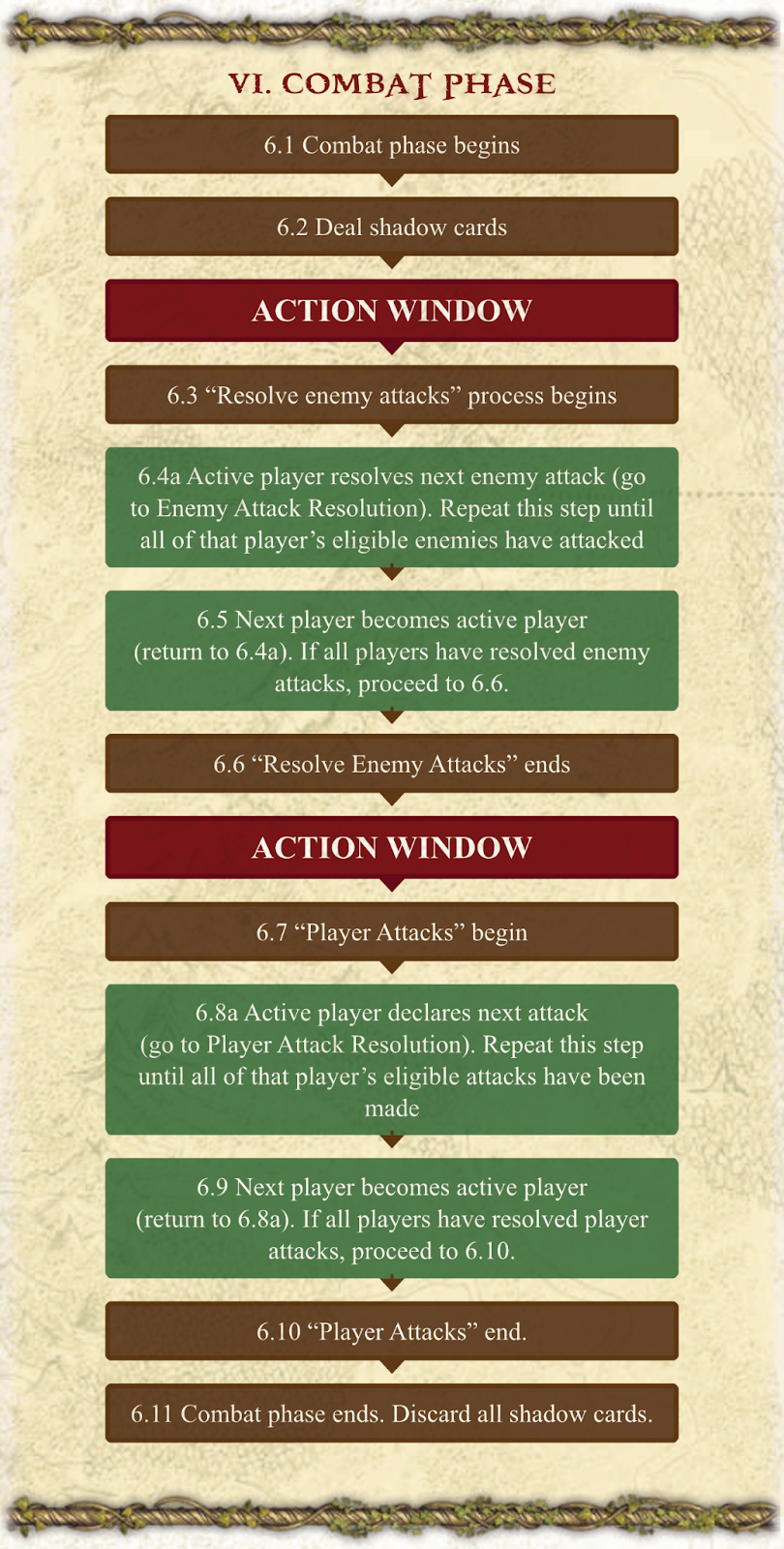
ALeP’s Note: With the release of the Rules Reference there were some changes to the Action Windows of the Combat Phase. On the one hand, this allowed players to do useful new things, like being able to play Meneldor’s Flight [SoM 76] in the Action Window between steps 6.8.3 and 6.8.4 of the Player Attack Resolution to save a Vassal of the Windlord [SoM 98] from being discarded by its own effect. On the other hand, there was no longer an Action Window between Steps 6.6 and 6.7 of the Combat Phase, which for example meant that, to be able to use the Action onWestfold Outrider [TVoI 6/RoR 6] to engage an enemy in the staging area during the Combat Phase without being attacked by that enemy, a solo player needed to be engaged with another enemy already.
This also impacted the use of the event Helm! Helm! [TToS 12/TTTo 18], since a previous FAQ about Elevenses [TDC 36/TDCHE 49] (see item #2.87 of our Semi-official Errata and FAQ 1.10 page) clarified that events that say “play only after [specific timing]” are meant to be played only immediately after the specific timing.
By reaching out to Caleb Grace about this issue we were able to discover that the removal of that Action Window was likely an oversight and that he would play as if it was still there (see item #3.381 of our Semi-official Errata and FAQ 1.10 page). By making a poll on Discord, Facebook, and other channels we also confirmed that the vast majority of players played as if that Action Window was present.
Through the combination of all these things, we reached the conclusion that it would be easier and simpler for everyone if the Action Window between Steps 6.6 and 6.7 was reinstated.
Community Consensus
The following section includes a series of fixes to specific cards and rules addenda about which we did not have specific developers’ answers to work with, but the issues were still glaringly obvious so we worked out a community consensus, while we wait to hear an official answer.
Any text that we propose to change will be highlighted by using red strikethrough for the old text and green for the new text.
Revised Core Set [RevCORE]
Mirkwood Paths Campaign Cards [RevCORE 129-131]
All three Mirkwood Paths (Part 1, Part 2, and Part 3) Campaign Cards show an incorrect encounter set icon (The Tower of Cirith Ungol from The Mountain of Fire/The Return of the King Saga Expansion). The correct encounter set icons (Passage Through Mirkwood, Journey Along the Anduin, and Escape from Dol Guldur respectively) can be found on the rules sheet.
ALeP’s Note: We tried to ask for clarification on this situation, even though the mistake is quite obvious, but we have not yet received an official answer from FFG about this so we will classify this as a Community Consensus fix for now.
Khazad-Dûm Expansion [KD] and Dwarrowdelf Expansion [D]
Plundered Armoury [KD 34] – Durin’s Greaves [D 88] [added 20 September 2023]
ALeP’s Note: There is what we consider a typo on two encounter cards from the Khazad-Dûm & Dwarrowdelf expansions: in the game text of both of these cards, we find the word Armour instead of the word Armor used to refer to the attachment Trait, probably a mix up between the American English and British English spellings. The fact that we think this is a typo is further reinforced by the fact that, in all the translations we checked, both Armor and Armour are translated with the same identical word. Since this typo can lead, in some corner cases, to erroneous game interactions, we think these cards could be considered as using Armor. Since we have not yet received an official answer from FFG about this so we will classify this as a Community Consensus fix for now.
Against the Shadow Expansion [AtS]
Morgul Sorcerer [AtS 149] [added 28 August 2024]
The shadow effect on this enemy could read: “Defending player must either place 1 progress token on To the Tower, or treat this attack as undefended.”
ALeP’s Note: As originally written this was a “must do A or B” choice, where the players must attempt to perform the first task and can perform the second task instead only if the first task cannot be performed. Since option A can always be performed in this scenario (until you lose for having 10 progress tokens on To The Tower [AtS 147]) it seems quite likely to us that the intent was for it to be a “must do either A or B” choice, where the players may choose which of two options to perform, although they must choose one that can be completely fulfilled, if able. Since we have not yet received an official answer from FFG about this we will classify this as a Community Consensus fix for now, but note that there are many official errata to cards from that same cycle that added a missing “either” to an “A or B” choice granted by an encounter card (like Counter-attack [AtS 106], The Ambush Side B [AtS 117] and Impenetrable Fog [AtS 157]).
The Grey Havens Expansion [TGH] and The Dream-chaser Expansion [TDC]
Sahir’s Pursuer [VaBNM 5] [added 31 January 2025]
Could have the card type Ship-enemy, instead of Enemy.
ALeP’s Note: This is clearly a mistake, since the lack of the Ship-enemy type means that Sahir’s Pursuer could be blocked by normal characters and not only by Ship-objectives like is the case for Ship-enemies (and damage from its undefended attacks would go on hero and not an Ship-objective). This clearly go against the normal rules and intent for these scenarios, so we are quite sure this needs to be fixed.
Patrol Ship [TCoCNM 2] [added 31 January 2025]
Could have the card type Ship-enemy, instead of Enemy.
ALeP’s Note: This is clearly a mistake, since the lack of the Ship-enemy type means that Patrol Ship could be blocked by normal characters and not only by Ship-objectives like is the case for Ship-enemies (and damage from its undefended attacks would go on hero and not an Ship-objective). This clearly go against the normal rules and intent for these scenarios, so we are quite sure this needs to be fixed.
Ered Mithrin Campaign Expansion [EMCE]
Beldis [EMCE 187] [added 22 September 2025]
Could have the Woodman trait instead of the Woodsman trait.
ALeP’s Note: This is clearly a typo, the Woodsman trait does not exist on any other card of the game, while the Woodman trait is present on several cards, mainly from that cycle, like Haldan [EM 26/EMHE 7]. As it stands, cards like Woodman Lore [TVoM 141] would not be able to target Beldis properly. All things considered, we are quite sure of this proposed change.
The Fellowship of the Ring Saga Expansion [TFotR]
The Great Bridge [TFotR 122] [updated 19 December 2023]
Could read: “Response: When The Great Bridge is explored, discard a hero from play to deal X damage to The Balrog. X is that hero’s threat cost. Then, The Balrog loses the indestructible keyword all keywords for the remainder of the game. Any player may trigger this response.”
ALeP’s Note: When this card was reprinted for The Fellowship of the Ring Saga Expansion, its wording was changed to better address a question that was often asked about it: Does the phrase “all keywords” include“immune to player card effects” too? The answer is no, since “immune to player card effects” is not a keyword, as explained in FFG FAQ 1.7. Caleb Grace further explained (see item #3.158 of our Semi-official Errata and FAQ 1.10 page) that he was leaving open future design space for Nightmare mode with that wording. Indeed, The Balrog ended up being able to gain the Archery and Regenerate keywords in Nightmare mode, which could then be removed by The Great Bridge’s Response. The re-released version of The Great Bridge from The Fellowship of the Ring does remove the confusion about “immune to player card effects”, but negatively impacts Nightmare mode. So, we recommend reverting the wording to the original version present in The Road Darkens Saga Expansion.
Various Expansions
Enemies and locations that “cannot leave the staging area” [added 16 November 2023]
In a few FFG scenarios there are enemies and locations that have the text “cannot leave the staging area”, be it by themselves or through quest effects. While this text is present to allow those enemies and locations to act in certain specific ways in the scenario in regard to travel, engagement, and combat, it can sometimes create a small “paradox” when the victory condition is tied to defeating those enemies or exploring those locations (and not simply them not having any hit points/quest points remaining or something else), since “cannot leave the staging area” also implies that they are not discarded from play for having damage equal or greater than their Hit Points or progress equal or greater than their quest points. To clarify these situations we propose the following errata:
Durin’s Bane [D 150]
This card is from the Shadow and Flame scenario, part of the Dwarrodelf Expansion.
Could read: “Durin’s Bane cannot leave the staging area (except by Dark Pit’s effect), is considered to be engaged with each player whose threat is 1 or greater, and attacks each of those players in turn during the combat phase (deal and discard a new shadow card each attack).”
The Crossing at Tharbad [TRM 71]
This card is from the Trouble in Tharbard scenario, part of The Ring-maker expansion.
Could read: “Immune to player card effects. Cannot leave the staging area (except by being explored).”
Midwinter’s Crux [AA 156/AACE 128]
This card is from The Battle of Carn Dûm scenario, part of the Angmar Awakened expansion.
Could read: “Thaurdir cannot leave the staging area (except by being destroyed), is considered to be engaged with each player, and attacks each player in turn during the combat phase (deal and discard a new shadow card for each attack). At the end of the round, if Thaurdir is Captain side faceup, flip him.”
Dagnir [EM 125/EMCE 110]
This card is from the Mount Gundabad scenario, part of the Ered Mithrin expansion.
Could read: “While there are 5 or more quest cards in the victory display, Dagnir cannot leave the staging area (except by quest card effects) and is considered to be engaged with each player.”
Urdug [EM 157/EMCE 124]
This card is from the Fate of Wilderland scenario, part of the Ered Mithrin expansion.
Could read: “Immune to player card effects. Cannot leave the staging area (except by being destroyed).”
Bolg [OtD 53]
This card is from The Battle of the Five Armies scenario, part of The Hobbit Saga expansion.
Could read: “Cannot leave the staging area (except by being destroyed).”
ALeP’s Note: To support this proposal of ours we would like to point you towards item #3.025 of our Semi-official Errata and FAQ 1.10 page, which is specific for a single case and gives a slightly different take for a new wording, and towards item #3.389 of our Semi-official Errata and FAQ 1.10 page. Both of those items are in our opinion quite clear about what was the designer’s intent for these situations, though they do not provide a definite wording which we are then supplying.
Rules Addenda
There are a few instances where we felt that the official rules lacked clarity or failed to cover some aspects of the game, so we propose these additions to the rules.
Setup Step 0
This is a new Setup step, which takes place before Step 1 as indicated in the Core Set rules, where a player may choose a contract for their deck. The deckbuilding and hero requirements of the contract are now active, but the contract has not yet entered play and its Setup text does not yet trigger. The contract will enter play during Setup Step 2 alongside the heroes.
ALeP’s Note: It was previously unclear how a contract’s deckbuilding restriction would function if it is not put into play until after the deck is chosen. This does contradict the rules for the timing of contracts entering play found in the A Shadow in the East box, but we believe this approach makes it easier to understand how to apply the deckbuilding restrictions.
Your Collection
If a card ability refers to a player’s collection (for example, “search your collection”), it refers to the leftover set of cards from which that player’s deck, heroes (as well as any other player’s deck and heroes that used the same set of player cards) and encounter deck(s) for the quest were assembled.
Cards from the [baggins] and [fellowship] spheres are only considered part of your collection if you are playing The Hobbit Saga and The Lord of the Rings Saga respectively. Treasure cards are only considered part of your collection if you are playing The Hobbit Saga and you “discovered” them. Boons and burdens are only considered part of your collection if you are playing Campaign Mode and they were in your Campaign Pool when you assembled the deck(s) for a quest.
ALeP’s Note: This means that when you are using The Burglar’s Turn [TVoM 24], your loot deck can only contain attachment boons you have earned and Fellowship attachments when you are playing The Lord of the Rings Saga quest. Note that treasures are their own distinct card type, and are not considered attachments.
Moving, Discarding, Removing, Spending, Paying, and Losing Tokens [added 15 May 2022]
1. To “move” a token, take it from one card or card’s pool and place it on another card or in another card’s pool, without placing it in the token bank.
2. To “discard” or “remove” a token, place it directly in the token bank. These two terms are equivalent and can be used interchangeably.
3. To “spend” or “pay” a token, place it directly in the token bank. These two terms are equivalent and can be used interchangeably.
These three definitions are mutually exclusive. For example, a spent/paid token is not considered discarded.
Losing a token is a blanket term that includes moving, discarding, removing, spending, and paying. Any time the number of tokens on a card or in a card’s pool is decreased, that card or card’s pool has lost one or more resources.
ALeP’s Note: Item 1.25 of the Official FAQ already covered the “Collecting, Adding, Moving, and Gaining Resources” portion of the terms related to the use of resource tokens, so we wanted another similar item that covered these other terms.
Enemies engaged with multiple players and additional attacks [added 14 April 2023]
In the event that an enemy which is considered to be engaged with multiple players is dealt a shadow card that triggers an additional attack from that enemy, but without specifying “against the defending player” or “against you”, the intent is that the additional attack is made against that same defending player the shadow effect triggered against. Examples of this are when City Guard [TVoM 37] is dealt The King’s Elite [TVoM 39] as a shadow card in The City of Ulfast while it’s considered to be engaged with multiple players based on their current threat or when The Two Watchers [TMoF 70/TRotK 95 (enemy side)] is dealt Deep Shadows [TMoF 62/TRotK 153] as a shadow card during Stage 1B or 3B of The Tower of Cirith Ungol.
ALeP’s Note: The resolution of this particular edge case is not addressed in the rules, so we propose what for us is the most simple and easy approach to the situation.
Starting Hand and Synonyms [added 26 May 2024]
The set of cards that are drawn by a player during Setup (before or after a mulligan) is usually referred to by the rules as the “starting hand”. There are a few sparse official cards that use slightly different terms, for example, Galdor of the Havens [TGH 2/TDCHE 8] uses “setup hand” while the Campaign Cards for The Battle of Carn Dûm [AACE 188] and The Dread Realm [AACE 193] use “opening hand”. We want to clarify that all those terms are synonyms and refer to the same thing. Galdor’s Response can be applied only to the first set of cards drawn since a player has only one chance to take a mulligan so the replacement effect can only be applied at that time.
ALeP’s Note: We wanted to streamline the use of terms used when referencing the cards drawn during Setup, but to avoid issuing some non-essential errata we propose this alternate approach.
Deckbuilding limitation text [added 29 July 2025]
Text that influences how many or which cards can be included in a deck during deckbuilding (for example “limit XX per deck”, “cannot include XX”, “cannot be included in your deck”, “your deck must contain XX”, “your minimum/maximum deck size is XX”, “your deck must be exactly XX” etc.) is active even before the game begins. This is true for contracts, allies, attachments, events, side quests etc.
ALeP’s Note: It was never clarified by FFG that text like “limit 1 per deck” or “you cannot include allies in your deck” is meant to be active also during deckbuilding, even though card text is not active out of play, but the intent was always clear to everyone. We are simply making it an explicit rule.
Free to Choose List [FTCL]
We know that game text not written on the cards adds mental overhead to playing the game. For that reason, our philosophy is to be as sparing as possible and try to preserve a card’s common use case, even with the optional FTCL. As was the case with FFG’s errata, the FTCL is not about balancing overpowered cards. We only focus on cards that, when combined with certain other cards, create novel and “game-breaking” effects beyond what the original designers likely intended. Cards that lead to infinite combos or trivialize a whole aspect of the game for multiple players are examples of effects that might qualify for the FTCL. A card like Steward of Gondor [CORE 26], while very powerful, would not qualify for the FTCL, as it seems to be used as intended, and any modification is likely to impact its regular use case.
In addition to some card changes, the FTCL contains a few minor rule changes, not all of which are related to powerful combos, but in some cases just to help simplify areas of the official rules that we have found particularly confusing for players. Since these changes directly contradict printed cards or official rulings, we have placed them in the FTCL.
Finally, in light of FFG’s willingness to introduce small wording updates and mechanical changes to certain cards in their revised content (such as the Noble trait added to Dáin Ironfoot [SoM 116/DoD 1] in the Dwarves of Durin Starter Deck), we may suggest such changes in a few circumstances, such as when we re-release an official card inside an ALeP product. Note that the only official cards we re-release currently are the alt-art promos in our standalone scenario packs.
Any text that we propose to change will be highlighted by using red strikethrough for the old text and green for the new text.
Core Set/Revised Core Set [CORE/RevCORE]
Glóin [CORE 3]
Could read: “Response: After Glóin suffers damage, add 1 resource to his resource pool for each point of damage he just suffered (to a maximum of 3 resources per round).”
ALeP’s Note: There is an infinite combo involving Glóin, Elrond [D 128/EoL 31], and Warden of Healing [D 83], which can allow one player to absorb an unlimited amount of damage every round. It depends on all the cards in this combo not having a limit on their ability. So we present a limitation to Glóin, as we believe that his unlimited resource generation was not intended. We feel that a limit of 3 resources per round preserves his use case in most decks, and might even encourage players to return to a hero that they may have previously considered “broken”.
Faramir [CORE 14]
Could read: “Action: Exhaust Faramir to choose a player. Each character controlled by that player gets +1 [willpower] until the end of the phase. (Limit twice per phase.)”
ALeP’s Note: When the Core Set was released, a repeatable way to ready allies did not exist, so Faramir was trickier to abuse. However, the lack of a limit has had an oversized impact on the design space for repeatable ally readying, due to the disparity in Faramir’s exhaust ability compared to other allies. By limiting his ability to twice per phase, we preserve existing decks that might be using Messenger of the King [TVoM 134] or Narya [TGH 15/DCHE 71] to get a single extra use out of Faramir, while opening up the design space for ally readying effects that would otherwise result in Faramir exhausting 3 or more times and trivializing the quest phase.
Shadows of Mirkwood Expansion [SoM]
Rivendell Minstrel [SoM 8] [added 01 March 2024]
Could have the Traits: Noldor. Minstrel.
ALeP’s Note: The Minstrel trait had no mechanical value before (aside from very fringe cases), so the lack of it on this card was only a thematic issue. Now that we have introduced a new Minstrel and Instrument archetype we felt it was only right to add the Minstrel trait to this card so that it might better fit into the archetype.
Brand son of Bain [SoM 72] [added 07 September 2023]
Could have the Traits: Dale. Noble. Warrior.
Could read: “Response: After Brand son of Bain attacks and defeats destroys an enemy engaged with another a player, choose and ready one of that player’s characters. (Limit once per phase.)”
ALeP’s Note: We made a few changes to this card, of three different kinds:
- Combo fix: the “limit once per phase” was added to avoid a combo between Brand son of Bain and Tactics Merry [TBR 3/TFotR 4] that allowed them to ready each other during the same attack. This would, amongst other things, allow them to attack and possibly kill almost all the enemies on the table when combined with a way to give Merry the Ranged keyword.
- Rebalancing changes: removing the word “another” allows Brand son of Bain to have an ability in solo games. The addition of the Noble and Warrior Traits is in line with the changes made by FFG to a few cards in the Revised products.
- Wording update: the change from “defeats” to “destroy” is simply meant to bring this card’s game text in line with all the other official player cards (Brand son of Bain being the only official player card that uses “defeats” while referring to an enemy), while we cut the “choose and” part since it was completely redundant.
Elfhelm [SoM 100]
Could read: “Response: After your threat is raised as the result of questing unsuccessfully, or by an encounter or quest card effect, reduce your threat by 1. (Limit once per round.)”
ALeP’s Note: In most cases, Elfhelm offers a good counter to quests that use a threat mechanic as a primary obstacle to overcome. We want to preserve that use case while limiting his ability to completely trivialize such quests.
Dwarrowdelf Expansion [D]
Word of Command [D 84] [added 31 January 2025]
Could have the Trait: Spell.
ALeP’s Note: The Spell Trait had no mechanical value before, so the lack of it on this card was only a thematic issue. Now that we have introduced cards that care about the Spell Trait we felt it was only right to add it to this card.
Path of Need [D 103/DoG 34]
Could also contain the text: “Remove Path of Need from the game at the end of the round or after it leaves play.”
ALeP’s Note: This card can be used in conjunction with recursion effects to be kept on the active location almost indefinitely, trivializing questing and/or combat for all players. This change preserves what we feel is its intended use: an emergency card to get out of a temporary bad spot.
Heirs of Númenor Expansion [HoN]
Blood of Númenor [HoN 13]
Could read:
“Attach to a Gondor or Dúnedain hero. Limit 1 per hero.
Action: Exhaust Blood of Númenor and spend 1 resource from attached hero’s resource pool to give attached hero +1 [defense] for each resource in its resource pool until the end of the phase. (Limit once per phase.) (Limit +3 [defense].)”
ALeP’s Note: As with Gondorian Fire below, we feel that the ability to stack multiple of these on a single hero and achieve +20 [attack] or [defense] for a couple of resources can trivialize quests with big enemies and is an unintended use case. The change would still provide what we see as its intended use case: a repeatable way to get a modest attack boost for the cost of a resource.
Against the Shadow Expansion [AtS]
Gondorian Fire [AtS 85]
Could read:
“Attach to a Gondor or Dúnedain hero. Limit 1 per hero.
Action: Exhaust Gondorian Fire and spend 1 resource from attached hero’s resource pool to give attached hero +1 [attack] for each resource in its resource pool until the end of the phase. (Limit once per phase.) (Limit +3 [attack].)”
ALeP’s Note: See Blood of Númenor above.
Book of Eldacar (AtS 59) [added 26 May 2024]
Could read: “Action: Discard Book of Eldacar to play any [tactics] event card in your discard pile as if it were in your hand. Then, place that event on the bottom of your deck. Remove Book of Eldacar from the game.”
Map of Earnil (AtS 87) [added 26 May 2024]
Could read: “Action: Discard Map of Earnil to play any [spirit] event card in your discard pile as if it were in your hand. Then, place that event on the bottom of your deck. Remove Map of Earnil from the game.”
Tome of Atanatar (AtS 109) [added 26 May 2024]
Could read: “Action: Discard Tome of Atanatar to play any [leadership] event card in your discard pile as if it were in your hand. Then, place that event on the bottom of your deck. Remove Tome of Atanatar from the game.”
Scroll of Isildur (AtS 142) [added 26 May 2024]
Could read: “Action: Discard Scroll of Isildur to play any [lore] event card in your discard pile as if it were in your hand. Then, place that event on the bottom of your deck. Remove Scroll of Isildur from the game.”
ALeP’s Note: the Record attachments (especially the Scroll of Isildur and the Tome of Atanatar) are part of some heavy recursion engines that might be considered game-breaking. That’s why, to still preserve the Record attachments use case but also limit those recursion engines, we propose to have the Record attachments remove themselves from the game after their Action is used.
The Ring-maker [TRM]
Mirkwood Pioneer [TRM 91] [added 18 December 2025]
Could read: “You may give Mirkwood Pioneer doomed 1 when you play it from your hand. If you do, it gains: “Response: After you play Mirkwood Pioneer, choose a location or enemy card in the staging area. Until the end of the round, the chosen card does not contribute its [threat].”
ALeP’s Note: Since there are many objective cards that add threat to the staging area, often as an integral part of a scenario mechanic like The Defense of Helm’s Deep [TToS 33/TTTo 53] or The Ring Comes to Gondor [TMoG 20b], we feel that this card might be working outside its original intent, so we propose to limit it to locations and enemies.
Angmar Awakened Expansion [AA]/Angmar Awakened Hero Expansion [AAHE]
Rallying Cry [AA 3/AAHE 20]
Could read: “Valour Action: Until the end of the phase, add each ally that leaves play to its owner’s hand instead of placing it in the discard pile add the next 3 allies that leave play to their owner’s hand instead of placing them in the discard pile.”
ALeP’s Note: The original version of this card can be used in infinite combos using free allies that leave play immediately after being played (for example, an ally like Ioreth [TDC 117/TDCHE 56] in a quest that damages allies upon entering play, which in conjunction with Horn of Gondor [CORE 42] can create unlimited resources). We feel that this change would limit this combo while having the least significant effect on the regular use cases of the cards involved.
Silver Harp [AA 90/AAHE 46] [added 01 March 2024]
Could read: “Attach to a [spirit] or Minstrel hero. Restricted.”
ALeP’s Note: While creating the new Instrument cards we initially took inspiration from this card. Now that we have our finished product, players may wish to bring the attachment text on Silver Harp in line with the rest of the Instruments. This allows the Silver Harp to fit in better with Minstrel decks and may be easier to remember when playing alongside other Instrument cards.
Doom Hangs Still [AA 117/AAHE 18] [updated 18 December 2025]
Could read:
“Play only if no other copies of Doom Hangs Still have been played during this game.
Planning Action: Until the end of the round, players do not raise their threat from questing unsuccessfully.
Valour Planning Action: Raise each player’s threat by 2 to skip the quest phase reveal 1[pp] fewer cards from the encounter deck during the staging step and skip quest resolution this round.”
ALeP’s Note 1: Without the limit, this card can be used in conjunction with threat reduction and recursion to allow players an effectively unlimited number of rounds to get set up. With this change, we seek to limit this exploit while preserving what we believe is its intended use case.
ALeP’s Note 2: The change to the Valour Planning Action was brought forth by how skipping the entire quest phase might allow players to bypass steps and triggers crucial to many scenarios mechanics, such as the Forced effect on The Black Gate [TMoF 24/TRotK 109] inThe Black Gate Opens or having to reveal cards from the Wave decks in The Mirror of Galadriel. With this change, we try to preserve this card’s intent, while also allowing for those mechanics to still work properly.
Ered Mithrin Expansion [EM]/Ered Mithrin Hero Expansion [EMHE]
Mithril Shirt [EM 152/EMHE 49]
Could read: “Response: When attached hero is dealt any amount of damage, reduce that amount by 1. (Limit 3 times per phase.)”
ALeP’s Note: In conjunction with Vigilant Guard [TDC 113/TDCHE 33], this card can absorb an incredible amount of damage each round, including all archery damage. Even Caleb Grace noted that this combo was not meant to be and said that it would need some fixing (see item #3.318 of our Semi-official Errata and FAQ 1.10 page), but it never come to pass in any official form. Between the two abilities, we see the absorption of damage as more problematic than the movement of damage, so we suggest a limit on Mithril Shirt that should preserve the ordinary use of both cards.
The Vengeance of Mordor Expansion [TVoM]
Host of Galadhrim [TVoM 36/EoL 23]
Could read: “Planning Action: Return each Silvan ally you control to your hand. Then, play each of those allies from your hand one at a time at no cost. Remove Host of Galadhrim from the game.”
ALeP’s Note: This card can be used in an infinite combo to generate unlimited resources and card draw for all players on the table, using the Galadhrim Weaver [AA 89/AACE 42]’s ability to recur itself. Removing it from the game after use should preserve its ordinary use while preventing this combo.
Well Preserved [TVoM 85]
Could read: “Response: At the beginning of the round, exhaust The One Ring and raise your threat by 1 to heal all up to 3 damage from attached hero.”
ALeP’s Note: With just a couple hit point attachments, this card can be used to absorb all combat damage every round without defending for the cost of +1 threat. We have found this to heavily restrict the scope for future healing effects. We are not entirely sure what the amount of healing the designers had in mind for this card’s “regular use”, but we have settled on 3 as a reasonable amount, given the cost.
Song of Healing [TVoM 112]
Could read: “Action: Discard 1 card from your hand to heal 1 damage from attached hero. Any player may trigger this effect. (Limit twice per round.)”
ALeP’s Note: In conjunction with Elven-light [AA 145/AAHE 49], this card presents unlimited healing and card draw opportunities given a continued supply of resources. We settled on this limit due to the similarity of the effect with Imladris Caregiver [TDC 8/TDCHE 55].
Messenger of the King [TVoM 134] [added 07 November 2024]
Side A
Could read:
“You cannot choose more than 2 heroes during setup.
Setup: Choose a non-neutral unique ally from your deck and put it into play. Add the sum of that ally’s printed [willpower], [attack], [defense], and hit points to your starting threat. Then, flip this card over and attach it to that ally.
When choosing your starting heroes, choose a non-neutral unique ally from your collection to count as one of them, with a threat cost equal to the sum of its [willpower], [attack], [defense], and hit points.
Forced: When you put your starting heroes into play, flip this card over and attach it to the chosen character.”
Side B
Could read:
“Attached ally character loses the ally card type and gains the hero card type, with a threat cost equal to the sum of its printed [willpower], [attack], [defense], and hit points.
Attached character cannot be readied more than once per phase.
Messenger of the King is immune to card effects while attached character is in play. If attached character leaves play, remove Messenger of the King from the game.”
ALeP’s Note: When we were developing the Beyond the Original Bargain [THo 69] contract, we soon realized that Messenger of the King would be an issue since it was basically impossible to reconcile its official wording with how we wanted it to interact with other contracts. So we propose this alternate wording that will allow players to play interesting combinations like Messenger of the King and Grey Wanderer [TVoM 74] without going against the original intent of Grey Wanderer. Another intent of this wording we propose is to make the Messenger of the King hero work even more like an actual hero than before; by giving it a threat cost, a Messenger of the King hero can now work effectively with things like Mirlonde [AtS 32] and Inspiring Presence [TDC 143/TDCHE 51]
On the Doorstep Saga Expansion [OtD]
Thrór’s Key [OtD 16] [added 14 April 2023]
Could read: “Response: After a location is added to the staging area, if Thrór’s Key is attached to a hero, attach Thrór’s Key to that location. While attached to a location, Thrór’s Key gains: “Treat attached location’s printed text box as blank, except for traits.”
ALeP’s Note: As written, Thrór’s Key keeps its Response even when it’s attached to a location. That means that if locations keep getting revealed, it can keep “jumping” from one location to another for the whole game, providing consistent and repeatable location blanking. This can also effectively eliminate all Travel costs at higher player counts. We believe that was not the use case intended for it (especially looking at the two errata received by a similar card, Thrór’s Map [OHaUH 13/DoD 19]) so we propose this alternate wording to limit Thrór’s Key’s Response to only one use.
Bilbo’s Magic Ring [OtD 19] [added 01 March 2024]
Could read: “Action: Exhaust Bilbo’s Magic Ring and raise your threat by 1 to gain 1 [baggins] resource add 1 resource to Bilbo Baggins’ resource pool. (Limit once per round.)”
ALeP’s Note: This card always had a bit of weird wording, but it still worked as intended, more or less. With the introduction of Lobelia, who can burgle Bilbo’s Magic Ring, we thought it was the best time to introduce an errata for this card. Just be careful when Lobelia claims Bilbo’s Magic Ring though, doing so during the Flies and Spiders scenario might be detrimental.
The Black Riders Saga Expansion [TBR]/The Fellowship of the Rings Saga Expansion [TFotR]
Merry [TBR 3/TFotR 4] [added 26 May 2024]
Could read: “Response: After Merry participates in an attack that destroys an enemy, ready another character that participated in that attack. (Limit once per phase.)”
ALeP’s Note: Tactics Merry has been used for a long time as a support to other attackers to ready them again for repeated attacks. This in particular enabled him and Brand son of Bain [SoM 72] to ready each other. We are proposing this limitation to Merry’s Response to avoid situations where Merry and another hero can trivialize combat, while still preserving the basic use case.
Rules Changes and Addenda
These rule changes and addenda are also part of the Free to Choose List.
(FTCL 1.01) Reworked Setup [added 01 March 2024]
The exact flow of the Setup of this game was always a bit of a gray area, especially with the introduction of Nightmare Mode, Campaign Mode and contracts (or Eru forbid all three of those together, maybe sprinkling in the XP introduced in the Dream-chaser Campaign). So, with the addition of a new player card type that we want to come into play at the very end of Setup, that is to say, the player objectives, we have decided to work on a new and revised approach to Setup. We are proposing, as part of our Free to Choose List, two different versions of a Reworked Setup: a more streamlined approach and a more in-depth approach. Note that the in-depth approach will also require a few changes to some official cards (listed at the end of it) to work properly.
ALeP’s Note: We hope this can help you players approach Setup in a more clear-cut fashion and that will make preparing games less of a headache. We also realize that it’s likely we have overlooked some corner case interactions, so please feel free to point out those so that we can further improve this resource for the community.
(FTCL 1.02) Doomed X on Player Cards [updated 07 November 2024]
Every event whose text includes the printed doomed keyword is considered to have the additional text: “Play only if no other copies of [name] have been played this round.”.
ALeP’s Note: It is possible to play many of the free doomed events on your opening turn and quickly build an unassailable board state before the encounter deck can respond. The threat cost of doing so can be easily mitigated later, once the game has been effectively won. This change is meant to preserve the ordinary use case of these doomed events while limiting their ability to overwhelm the encounter deck early on.
This limit on event cards is tied to that card’s title, so multiple events with the printed doomed keyword can still be played in the same round as long as they have different titles.
Card effects that “give” the doomed keyword (like Gríma [TVoI 2] or Steward of Orthanc [TH 37]) are not affected by this change, as those are not considered to be “printed” instances of the doomed keyword. Soldier of Isengard [TVoM 57] is also not affected, as it is not an event.
Here is a list of all cards currently affected by this change:
Legacy of Númenor [TVoI 11]
Deep Knowledge [TVoI 12]
The Wizard’s Voice [TVoI 13]
Power of Orthanc [TVoI 14]
The Seeing-stone [TVoI 15]
Close Call [TRM 5]
Waters of Nimrodel [TRM 145]
Horns! Horns! Horns! [TVoM 54]
Far-sighted [TVoM 58]
Reckless Attack [TVoM 87]
Defiant Challenge [TVoM 89]
(FTCL 1.03) Rule of 3
A single player cannot play or put into play a card with the same title more than 3 times in the same phase.
ALeP’s Note: In regular play, it is rare for a player to ever play the same card more than 3 times in one phase, so this rule should not affect most players. However, it does serve as a simple way to shut down infinite recursion decks, without needing to add every card with a recursive ability to the FTCL.
(FTCL 1.04) Player Elimination [added 07 November 2024]
Could read: A player is eliminated from the game if all of his heroes are killed they do not control any heroes in play.
ALeP’s Note: The original rule for this situation was only vaguely defined and many rulings were needed over the years to clarify many different situations. We propose a simpler and more intuitive approach to this. We know that this will contrast with a few past rulings, for example, those about Lost and Alone [D 124] and Sméagol [ASitE 72] flipping to Gollum [ASitE 73] while it’s your last hero, but we believe a simpler rule for this is more important than to preserve some rare corner cases. We are sorry for all those who loved to use Desperate Alliance [OtD 10] for some weird shenanigans.
The “in play” specification is needed because a player controls the card in its discard pile, so simply saying “if they do not control any heroes” would not have reached the intent.
 A Long-extended Party